The Michael Jackson movie doesn’t just fall short—it fundamentally misunderstands its subject. A biopic’s first duty is to illuminate the person behind the persona, to peel back the spectacle and reveal the human condition. Instead, what we get is a glossy, emotionally hollow retelling that mistakes chronology for insight, celebrity for depth, and performance for truth.
This isn’t just a misfire—it’s a betrayal of the biopic form.
The Core Failure: Confusing Fame
with Understanding
Biopics aren’t documentaries. They don’t need to be exhaustive, but they must be truthful in spirit. The Michael Jackson movie fails at this essential task by treating its subject like a museum exhibit rather than a living, breathing, contradictory man.
We see the glove. We hear the moonwalk. We endure the trial footage, again. But where is the fear? The loneliness? The psychological weight of growing up under the crushing gaze of fame?
Jackson’s life wasn’t just a series of hits and headlines. It was a study in identity erosion—the child star who never aged, the Black artist who defied genre and race expectations, the man who built Neverland not as a freak show, but as a refuge from a world that never let him be a child.
The film reduces all of this to montage sequences and dramatic reenactments of press conferences. It mistakes access to footage for access to truth.
Superficial Storytelling Over Emotional Depth
What defines a great biopic? Consider Ray, which didn’t just show Ray Charles playing piano—it showed how music was his language, his escape, his prison. Capote didn’t just recount the writing of In Cold Blood—it revealed how truth can consume the truth-seeker.
The Michael Jackson movie offers none of this interiority. The central performance—whether through casting, direction, or writing—lacks psychological nuance. We’re told Jackson was complex, but we’re never allowed to feel that complexity.
Take the transformation of his appearance. This wasn’t vanity. It was a layered response to vitiligo, body dysmorphia, trauma, and perhaps a deliberate blurring of racial and gender lines in a hostile industry. The film skims this with a single mirror scene and a line about “wanting to look different.” That’s not storytelling—that’s shorthand.
And the relationships? His bond with his father, Joe Jackson, is reduced to a few yelling matches. His connection with his children feels staged, sitcom-level affection. There’s no exploration of how his own fractured childhood shaped his parenting, or how his desire to protect his kids mirrored his own need for protection.
The Danger of Mythologizing Instead of Humanizing
One of the film’s biggest failures is its refusal to sit with discomfort. It wants Jackson to be beloved, so it avoids the harder questions—not just about the abuse allegations, but about the man’s own contradictions.
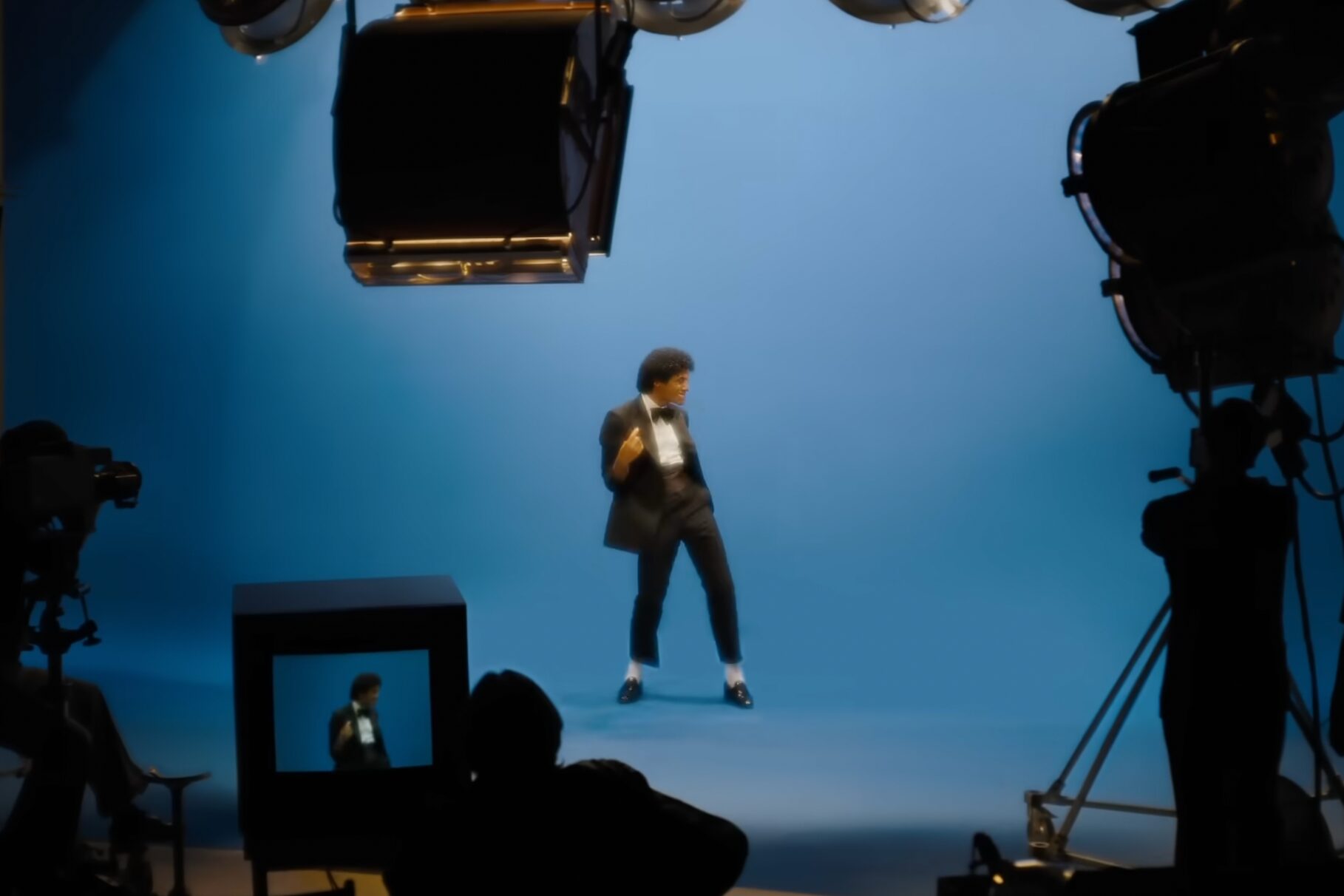
True humanization doesn’t mean absolving. It means showing the full picture: the genius and the fragility, the generosity and the isolation, the artistry and the alienation.
Instead, the film either defers to archival footage or retreats into musical spectacle. The concert scenes are dazzling, yes—but they’re also a distraction. They remind us why we loved Jackson, but they don’t explain who he was when the spotlight faded.
The most powerful moments in Jackson’s life weren’t on stage. They were in the quiet: a child rehearsing at 3 a.m., a man staring at his reflection, a father reading bedtime stories in a mansion built like a fortress. The film ignores these because they don’t sell tickets. But they’re the only moments that matter.
Misuse of Archival Material as a Crutch
Modern biopics love to splice in real footage. It creates a sense of authenticity. But when overused, it becomes a substitute for real storytelling.
The Michael Jackson movie leans heavily on news clips, interviews, and performance reels. It’s as if the filmmakers are saying: We don’t need to interpret—here’s the real thing.
But that’s lazy. Archival footage should contextualize, not replace, narrative. It’s the difference between showing a trial and showing how that trial shattered a man’s sense of self.
When the film cuts to the 2005 trial, it feels like we’re watching a documentary on mute, waiting for the verdict. There’s no exploration of Jackson’s state of mind, no sense of how the media circus distorted reality, no empathy for the toll it took. It’s presented as scandal, not tragedy.
And by hiding behind real footage, the filmmakers avoid making bold choices—choices that might have risked controversy but would have offered insight.
The Missed Opportunity of Neverland
Neverland is more than a ranch. It’s a symbol. A psychological landscape. A childhood dream turned cage.
The film shows us the rides, the animals, the guest list. What it doesn’t show is what Neverland meant.
For Jackson, it wasn’t just a playground. It was a declaration: I will create the childhood I was denied. It was also a fortress, a place where he could control the narrative, where no one could tell him to rehearse, to perform, to be someone else.
But the film treats Neverland like a curiosity—a rich man’s toy. It doesn’t explore how the estate became both sanctuary and prison, how the very thing that healed him also isolated him, how the children who visited were mirrors of his own lost youth.
By reducing Neverland to a setting, the film misses its emotional core.
The Music Isn’t Enough

Let’s be clear: the soundtrack is powerful. Hearing “Billie Jean” or “Man in the Mirror” still gives chills. But a biopic about a musician shouldn’t just replay the hits—it should reveal how those songs were born.
Great music biopics show creation as struggle. A Star is Born shows Ally writing “Shallow” in a burst of raw emotion. Rocketman shows Elton John and Bernie Taupin crafting lyrics in therapy-like sessions.
The Michael Jackson movie shows Jackson in the studio—headphones on, nodding. But we don’t see the process. We don’t hear the arguments, the revisions, the breakthroughs. We don’t understand how “Thriller” emerged from obsession, or how “Earth Song” was a cry for connection.
Songs aren’t just products. They’re diaries. The film ignores their emotional DNA.
Why This Matters Beyond One Film
The failure of this Michael Jackson movie isn’t just about one production. It reflects a broader crisis in biopics: the preference for nostalgia over truth, spectacle over substance.
We’re drowning in celebrity retrospectives that worship icons instead of examining them. We get what happened but never why. And in doing so, we strip these figures of their humanity.
Jackson deserves better. Not because he was innocent, but because he was real—flawed, gifted, damaged, visionary.
A true biopic would have shown him wrestling with his skin, his voice, his legacy. It would have asked hard questions without easy answers. It would have let us sit in the discomfort of loving an artist while questioning the man.
Instead, we get a highlight reel with a sad ending.
What a Better Biopic Would Look Like
Imagine a film that opens not with a concert, but with a silence. A man alone in a bedroom, adjusting his wig, applying makeup, preparing to become Michael Jackson once more. Not because he wants to, but because the world won’t let him be anyone else.
Imagine a narrative that treats his changing appearance not as a joke or a scandal, but as a psychological journey shaped by illness, trauma, and identity.
Imagine a scene where young Michael, after a brutal rehearsal, whispers to his pillow, “I wish I could just play.”
Imagine a biopic that doesn’t flinch from the allegations—but also doesn’t reduce him to them. One that explores how fame warps justice, how money shields and isolates, how loneliness can look like luxury.
That film hasn’t been made. And until it is, the story of Michael Jackson will remain incomplete.
The Michael Jackson movie had a duty—to honor the complexity of a man who changed music, culture, and race in America. It failed. Not because it lacked resources or access, but because it lacked courage.
Biopics shouldn’t comfort. They should challenge. They should make us rethink what we thought we knew.
If you’re going to tell the story of one of the most scrutinized humans in history, you owe it to him—and to us—to go deeper than the headlines.
Do better.
FAQ
What should you look for in The Michael Jackson Movie Fails at the Basic Duty of a Biopic? Focus on relevance, practical value, and how well the solution matches real user intent.
Is The Michael Jackson Movie Fails at the Basic Duty of a Biopic suitable for beginners? That depends on the workflow, but a clear step-by-step approach usually makes it easier to start.
How do you compare options around The Michael Jackson Movie Fails at the Basic Duty of a Biopic? Compare features, trust signals, limitations, pricing, and ease of implementation.
What mistakes should you avoid? Avoid generic choices, weak validation, and decisions based only on marketing claims.
What is the next best step? Shortlist the most relevant options, validate them quickly, and refine from real-world results.